
What I take on every flight (and what I often see others lacking)
After thousands of flights, my bag is always organized the same way. No unnecessary items, no forgotten essentials. Here are the accessories I consider essential — with my concrete recommendations, not a generic catalog.
1. The Vario: Your Eyes in the Invisible
Without a variometer, you're deaf to thermals. It's the basic instrument, the one that transforms flying into something intelligent. Recent models integrate GPS, altimeter, maps — but honestly, a good audible vario is enough for 90% of pilots. If you're starting out, a Flymaster GPS SD or a Compass C-Pilot will do the job perfectly without breaking the bank. Cross-country pilots opt for more comprehensive instruments like the XCTracer or Naviter's Oudie.
2. The Helmet: Not Your Ski Helmet
I insist: a helmet EN 966 certified, specific to free flight. Not a bike helmet, not a ski helmet, not a construction helmet. Free flight has its own types of impact (back of the head on landing, lateral impacts during soaring). A certified helmet costs between 80 € and 250 €. The price of an outing radio. And it protects something irreplaceable.
3. Gloves: Your Best Friends in Winter
Below 5°C at altitude, flying bare-handed is masochistic. But beware: overly thick gloves kill sensitivity to controls. I recommend specific paragliding gloves (Supair, Niviuk) or, failing that, thin winter cycling gloves. The compromise between warmth and sensitivity is the whole point.
4. The Windbreaker: Your Survival Blanket
At 2,000 m, the temperature can drop by 15°C compared to the ground. A technical windbreaker that fits in the palm of your hand can transform a difficult flight into an enjoyable moment. I never take off without one, even in summer. Especially in summer — thermals can take you much higher than expected.
5. Shoes: High-Top, Non-Negotiable
Paragliding landing is a 15 km/h run in the grass (at best). Unprotected ankles mean a sprain waiting to happen. Lightweight high-top hiking shoes are the minimum. And if you do hike & fly, your climbing shoes will be your flying shoes — two problems solved at once.
6. The Radio: Not a Gadget
During cross-country flights, a VHF radio allows you to warn other pilots, communicate with your retrieve driver, and report a problem. In school, it's the link with your instructor on the ground. Even on local solo flights, having a charged radio turned on to the site's frequency is a safety habit that could save your life one day.
7. A Good Bag: Not a Trash Bag
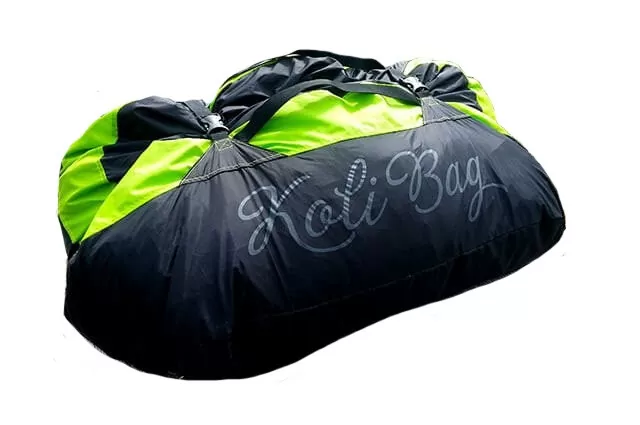
Seriously, the number of pilots I see stuffing their wing into a shapeless hiking backpack... A well-designed paragliding bag protects your wing from snags, distributes weight on your hips, and opens easily for takeoff. If you've invested 3,000 € in a wing, don't store it in a 15 € bag.
8. Water: Drink Before You're Thirsty
At altitude, the air is dry. Dehydration comes quickly and impairs concentration and decision-making. A 1.5 L hydration pack with an accessible tube is mandatory for flights longer than 45 minutes. And believe me, when you're stuck in a thermal at 3,000 m with no possibility of landing, you'll be glad to be able to drink.
9. Karabiners: The Parts Nobody Talks About
Your wing-harness karabiners are the only parts that physically connect you to your wing. They must be certified, locked, and inspected before every flight. A karabiner that accidentally opens in flight... I'll let you imagine. Prioritize auto-locking karabiners. And replace them every 5 years or as soon as they show signs of wear.
10. The Thing Nobody Puts in Their Bag
A whistle. Yes, a whistle. If you land out in an inaccessible spot, injured, with no phone signal, a whistle can be heard for hundreds of meters. It weighs 5 grams, costs 2 €, and can alert rescue services. I've had it attached to my harness strap since 1998 and only used it once — but that one time, it was worth it.
👉 All our accessories · Flight instruments · Need advice? Call us.
Fly safe,
Cyrille MARCK and the Rid'Air/CEM team