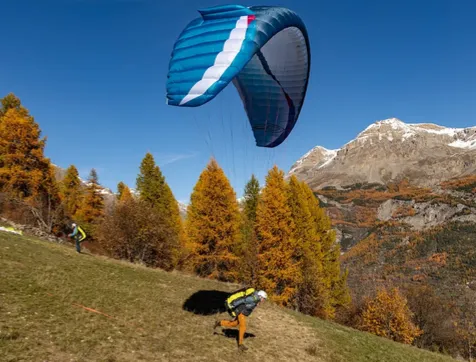
Asymmetric on EN-A/B: Reflex Before Fear
Asymmetrical closures are part of our daily flying environment. On EN-A or EN-B wings, stability is guaranteed, but it does not eliminate the risk of local turbulence or partial stall. Panicking always worsens the situation. Understanding what happens aerodynamically is already taking back control.
What Triggers the Collapse
An asymmetric collapse usually stems from a lift imbalance. A thermal vortex, a sudden air mass shift, or excessive speed can close the weakened side. The wing does not collapse by chance: it responds to an external constraint or a control imbalance. On category 1 wings, the safety margin is wide, but it still depends on your terrain and conditions reading.
Reacting Without Overcorrection
The saving maneuver is simple but must be automatic. One side closes? Do not pull the corresponding brake. You risk a full pitch or a spin. Keep your free hand ready, gently squeeze the opposite brake to maintain the axis, and check that your arms are not crossed. Let the wing recover its airflow. Most EN-A/B wings reopen on their own as soon as air flow is restored. If the closure persists, compress gradually without jerking.
Preparing the Flight Means Anticipating
Prevention is applied common sense. Staying cautious, progressive and practical in your approach remains the golden rule. Before takeoff, systematically check local weather, equipment condition and fatigue level. An EN-B wing does not excuse an approximate reading of the sky. Prioritize personalized advice and safety margins, especially when flying at altitude or in exposed areas. Field experience confirms that a controlled flight begins long before takeoff.
Practical Vigilance
- Keep hands on the brakes, fingers free and ready to react.
- Avoid using the speed bar in unidentified turbulence.
- Practice controlled collapses safely before chasing performance.
- Be honest with yourself about your weather limits and fatigue.
An asymmetric collapse is not inevitable. It is an aerodynamic signal requiring reading, not force. By staying focused on the fundamentals, you turn a stressful situation into a simple piloting exercise.
Fly safe,
Cyrille MARCK and the Rid'Air/CEM team