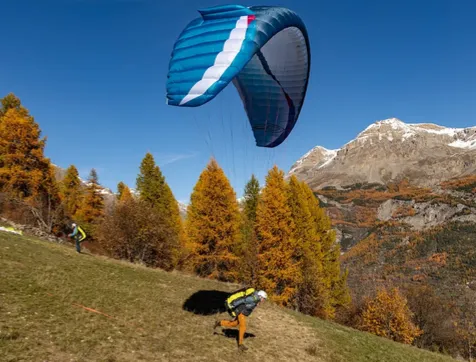
Hi everyone. Today we're talking about a wing that comes up a lot at the shop counter: the Ozone Rush, and more specifically the latest in the line, commonly called the Rush 6. It's one of those gliders everyone glances at sideways when they start to feel they're hitting a ceiling on their B-access wing. So let's lay things out calmly: what exactly is the Rush range, who is it for, and above all how do you know if you are ready to step up to it?
What exactly is the Rush?
The Rush is an EN-B certified wing, but careful, not just any B. It's what we call a high-B (B+ in counter-talk), meaning the top end of the B category. At Ozone it occupies a very precise spot: it's the XC-leisure wing that follows the school / B-access wing, and comes before the brand's pointier gliders.
In practical terms, it's the wing for the pilot who is no longer a beginner, who has a few seasons under their belt, who is starting to core thermals cleanly and wants to cover some ground. Not a competition wing, not a racing machine: a versatile glider, high-performing for its category, but still within a reassuring frame for someone who is progressing.
An honest note: the exact characteristics (weight ranges, cell count, aspect ratio, areas by size) change with each version and depend on the colour scheme. Rather than throwing approximate numbers at you, I'll point you to the Ozone product page in our shop for the up-to-date specs of the latest Rush. That's where you'll get the real figures, size by size.
Which pilot is the Rush range made for?
The answer fits in one sentence: the EN-B pilot progressing towards cross-country. That's exactly the band of pilots we see most in the shop, because 80% of paraglider pilots fly B. The Rush is typically a pilot's second or third wing.
Here's the typical profile:
- You fly regularly, not just two weekends a year.
- You can centre a thermal and stay in it, even when it gets a bit rough.
- You're starting to do your first little XC flights, your first transitions, your first flights that leave the home site.
- You find your current wing a bit "soft" in glide; you want more glide ratio and more speed to reach the next thermal.
- You're comfortable on take-off and landing in varied conditions.
If you recognise yourself in this, the Rush range is clearly in your lane.
What do we expect from a high-B wing like the Rush?
A high-B isn't a low-B with a bit more performance. It's a deliberate compromise between performance and accessibility. Here's what you're entitled to expect from a wing like the Rush:
Performance for cross-country
Better glide, better top speed, the ability to keep the leading edge open on bar. That's what lets you stretch your transitions and turn a local flight into a real little XC.
Healthy but more demanding behaviour
A high-B is still B-certified, so its behaviour during an incident is broadly healthy. But let's be clear: the reactions are sharper, more dynamic than a B-access. The wing talks to you more, it asks for more active piloting, especially in turbulent air. That's not a flaw, it's the price of performance — provided you have the level to pilot it actively.
Versatility
The Rush isn't a specialist. It has to do everything correctly: thermalling, transitions, soaring, a bit of hike-and-fly depending on the model. It's an all-rounder for the leisure pilot who wants a single wing for the whole season.
How do you know you're ready to move up to a high-B?
That's THE question. And the wrong answer is to move to a high-B because your mates did or because it looks cool. Stepping up to a high-B is earned, not out of pride but for safety. Here are the honest criteria to ask yourself:
| Criterion | Not ready yet | Ready for the high-B |
|---|---|---|
| Flight hours | A few dozen hours, regular flights | Several hundred hours, flying regularly year-round |
| Active piloting | You endure the wing's movements | You anticipate and damp with brakes/harness |
| Thermalling | You struggle to centre | You core cleanly, even tight |
| Incident management | A collapse freezes you up | You've done an SIV, you handle a collapse calmly |
| Flying goal | Pleasure flying above the site | XC, transitions, leaving the home site |
My old-hand advice: if you hesitate on even one line of this table, no big deal, it just means you've still got a little margin to build. And that's fine. Progressing in safety means neither too fast nor too slow. A short SIV course before moving to a high-B is by far the best investment you can make. Better to arrive on your Rush knowing exactly what it can do and how to react.
The Rid'Air advice
At Rid'Air we've been selling wings for a long time — the CEM dates back to 1977, so we've seen a few generations of gliders pass through. And our philosophy hasn't changed: we never push you towards a wing more performing than what you need. If you're not ready for a high-B, we'll tell you straight, and we'll save you your money.
On the other hand, if you're right in the band — a B pilot progressing, wanting a taste of cross-country — then the Rush range is an excellent candidate, and we'll be happy to advise you on the right size based on your actual all-up weight (not just your naked weight, mind, we're talking fully kitted out). Choosing the size is half the job on a high-B.
To help you place the Rush against the other wing families, I recommend two in-house reads: our comparison of EN-B+ (high-B) wings to understand the segment the Rush plays in, and our comparison of EN-B wings to situate the whole category. And if cross-country is calling, take a look at our distance flying guide — that's exactly this wing's playground.
In summary
The Rush range is Ozone's high-B XC-leisure wing made for the progressing B pilot who wants to cover ground. High-performing without being pointy, versatile, but more demanding than a B-access. The right moment to step up is when you core cleanly, you pilot actively, and cross-country starts itching. And always: an SIV first changes everything.
Want the exact specs of the latest Rush, size by size, and the lowest price on the market? It's all on our online shop. And for size choice or any doubt about your level, get in touch or come and see us in Oderen: we take the time to discuss your flying project before selling you anything.
Fly safe,
Cyrille MARCK et l'équipe Rid'Air/CEM