Les grandes familles de sellettes
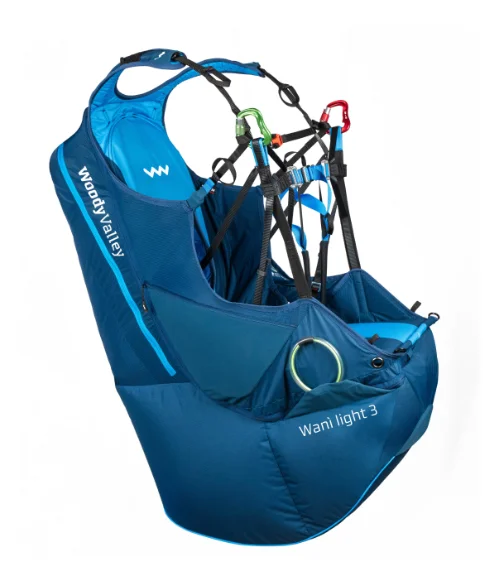
Il existe quatre grands types de sellettes : les sellettes standard à planchette, les sellettes cocon aérodynamiques pour le cross, les sellettes réversibles qui se transforment en sac à dos, et les sellettes ultralight pour la rando-vol. Chaque type a ses avantages, et le bon choix dépend avant tout de votre pratique et de votre morphologie — pas du marketing.
Le confort avant tout
Vous allez passer des heures dans votre sellette. L'assise, le soutien lombaire, la largeur et la profondeur doivent correspondre à votre morphologie. Chez Rid'Air, on fait systématiquement des essais en portique : on suspend la sellette, vous vous installez dedans, et on règle tout ensemble — hauteur des maillons, sangle ventrale, écartement des cuissardes, inclinaison du dosseret. C'est la seule façon de savoir si une sellette vous convient vraiment.
L'œil de l'expert — Le test en portique qui change tout
Un client est venu à Oderen avec un mal de dos chronique après chaque vol. Il volait sur une sellette cocon haut de gamme... mais trop petite pour sa morphologie. On l'a accroché au portique avec trois sellettes différentes, et en ajustant les réglages on a trouvé la bonne en 15 minutes — une Kortel Kolibri une taille au-dessus, avec un soutien lombaire repositionné de 3 cm. "J'aurais dû venir vous voir il y a deux ans", m'a-t-il dit. La sellette la plus chère n'est pas forcément la meilleure pour vous. Celle qui est bien réglée pour votre corps, si.
La protection dorsale
Airbag, mousse, ou protection rigide : la protection dorsale est un élément de sécurité passive essentiel. Les systèmes airbag se gonflent automatiquement en cas de choc et offrent la meilleure absorption d'énergie. Mais attention : un airbag mal gonflé ou mal positionné, c'est comme pas de protection du tout.
Conseil d'atelier — Ce que je vérifie sur chaque sellette
Quand un client nous apporte sa sellette pour un check-up, on vérifie systématiquement trois points critiques que beaucoup de pilotes oublient : l'état des mousses de protection (elles se tassent avec le temps et perdent leur capacité d'absorption), les coutures d'accrochage aux maillons (usure par frottement), et le bon fonctionnement de l'airbag (si équipé). Une sellette, ça s'entretient. On voit des sellettes de 10 ans avec des mousses de protection complètement aplaties — autant dire aucune protection.
Le poids, un critère clé
Pour la rando-vol, chaque gramme compte. Les sellettes light descendent sous les 2 kg, contre 5 à 8 kg pour une sellette cocon complète. Attention, un gain de poids se traduit souvent par moins de confort et de protection.
Ma recommandation personnelle
Si vous ne faites pas de rando-vol, ne sacrifiez jamais le confort pour le poids. Une sellette de 4-5 kg avec une bonne assise et un vrai airbag, c'est un investissement pour 10 ans de vols sereins. Parmi nos meilleures ventes : la Supair Altirando 3 pour les polyvalents (3,2 kg, cocon léger) et la Woody Valley Haska pour ceux qui veulent le top confort en cross.
Les réglages, le truc que personne ne vous explique
Une sellette neuve sortie du carton, c'est comme une paire de chaussures de ski pas réglée : ça ne peut pas aller. La hauteur des points d'accrochage, la tension de la ventrale, l'inclinaison du dosseret, le réglage de l'accélérateur — tout ça change radicalement le comportement en vol. Trop de pilotes volent pendant des années avec une sellette mal réglée et pensent que c'est normal d'avoir mal au dos ou de manquer de stabilité directionnelle.
Chez Rid'Air, chaque sellette vendue est réglée sur portique avant expédition si vous nous donnez vos mensurations (taille, poids, entrejambe). Et si vous passez au magasin à Oderen, on fait le réglage complet ensemble — c'est inclus, et ça prend 20 minutes qui changeront tous vos vols.
Venez essayer chez Rid'Air
Notre magasin à Oderen dispose d'un portique d'essai sellette. On vous installe, on règle, on ajuste — et vous repartez avec une sellette qui vous va vraiment. Si vous êtes loin, appelez-nous : on fait du conseil personnalisé par téléphone et on peut pré-régler votre sellette avant l'envoi.
Besoin d'un conseil ? Contactez-nous ou passez nous voir à Oderen.
Fly safe,
Cyrille MARCK et l'équipe Rid'Air/CEM