
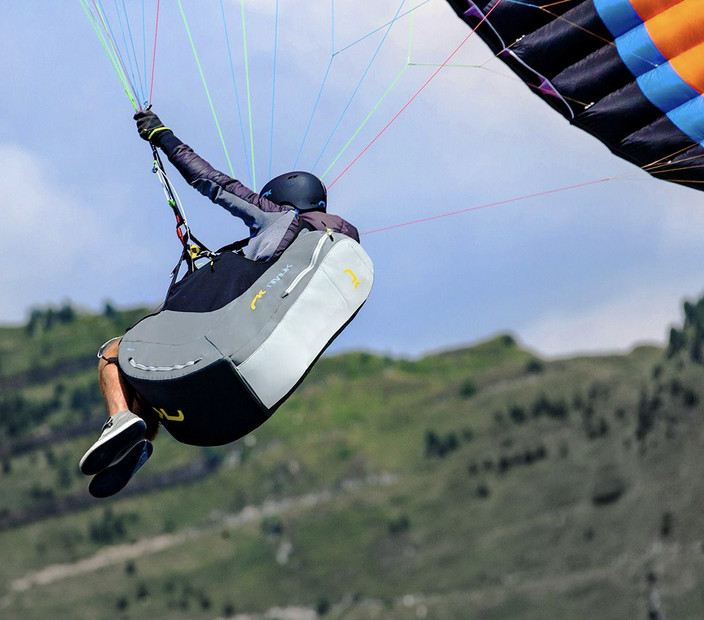
The Main Types of Harnesses
There are four main types of harnesses: standard harnesses with a seat board, aerodynamic cocoon harnesses for cross-country flying, reversible harnesses that convert into a backpack, and ultralight harnesses for hike-and-fly. Each type has its advantages, and the right choice depends primarily on your flying style and body type — not on marketing.
Comfort First
You'll spend hours in your harness. The seat, lumbar support, width, and depth must match your body type. At Rid'Air, we systematically perform harness rig tests: we suspend the harness, you get in, and we adjust everything together — carabiner height, chest strap, leg strap spacing, backrest recline. It's the only way to truly know if a harness is right for you.
Expert's Insight — The Rig Test That Changes Everything
A client came to Oderen with chronic back pain after every flight. He was flying a high-end cocoon harness... but it was too small for his body type. We hooked him up to the rig with three different harnesses, and by adjusting the settings, we found the right one in 15 minutes — a Kortel Kolibri one size up, with the lumbar support repositioned by 3 cm. "I should have come to see you two years ago," he told me. The most expensive harness isn't necessarily the best for you. The one that's properly adjusted for your body is.
Back Protection
Airbag, foam, or rigid protection: back protection is an essential passive safety element. Airbag systems inflate automatically upon impact and offer the best energy absorption. But beware: a poorly inflated or positioned airbag is like having no protection at all.
Workshop Tip — What I Check on Every Harness
When a client brings us their harness for a check-up, we systematically check three critical points that many pilots overlook: the condition of the protection foams (they compress over time and lose their absorption capacity), the attachment point stitching to the carabiners (wear from friction), and the proper functioning of the airbag (if equipped). A harness needs maintenance. We see 10-year-old harnesses with completely flattened protection foams — which is to say, no protection at all.
Weight, a Key Criterion
For hike-and-fly, every gram counts. Light harnesses weigh under 2 kg, compared to 5 to 8 kg for a full cocoon harness. Be aware that weight savings often mean less comfort and protection.
My Personal Recommendation
If you're not doing hike-and-fly, never sacrifice comfort for weight. A 4-5 kg harness with good seating and a proper airbag is an investment for 10 years of serene flights. Among our best sellers: the Supair Altirando 3 for versatile pilots (3.2 kg, light cocoon) and the Woody Valley Haska for those who want top comfort for cross-country.
Adjustments: The Thing Nobody Explains to You
A new harness straight out of the box is like a pair of ski boots that aren't adjusted: it just won't work. The height of the attachment points, the chest strap tension, the backrest recline, the speed system adjustment — all of this radically changes flight behavior. Too many pilots fly for years with a poorly adjusted harness and think it's normal to have back pain or lack directional stability.
At Rid'Air, every harness sold is adjusted on a rig before shipping if you provide us with your measurements (height, weight, inseam). And if you visit our store in Oderen, we'll do the complete adjustment together — it's included, and it takes 20 minutes that will change all your flights.
Come Try It at Rid'Air
Our store in Oderen has a harness testing rig. We'll set you up, adjust, and fine-tune — and you'll leave with a harness that truly fits you. If you're far away, call us: we offer personalized advice by phone and can pre-adjust your harness before shipping.
Need advice? Contact us or visit us in Oderen.
Fly safe,
Cyrille MARCK and the Rid'Air/CEM team