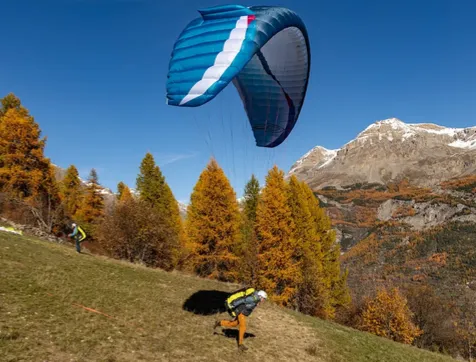
Landings are not a formality, they are the final flight phase
We spend hours learning to launch, managing thermals, or flying. Yet the descent to ground is often rushed due to overconfidence or lack of method. Good landings aren't improvised. They start at launch. Here are practical steps to touch down calmly and safely.
The approach: reading the ground and slope
As soon as you exit a thermal, your focus shifts forward. The goal isn't to aim for an exact centimeter-point, but to anticipate ground slope and obstacles. A landing hinges on balancing vertical and horizontal speed. On steep or cluttered terrain, flying a wider half-circle early gives you time to adjust. Don't force a straight-in final too soon. Let the slope carry you, but always keep a safety buffer.
The final phase: line of sight, body position, and pace
Your eyes dictate your path. Look far ahead toward your touchdown point, not under the wing. Body position must be stable: seated firmly in the harness, feet ready to absorb impact or run if needed. Pace—speed management—must be gradual. Avoid sudden brake input on final unless absolutely necessary. Let the wing fly its own path and make micro-adjustments with low brake inputs.
Manage energy without stress
Every pilot has their own rhythm. Some slow down early, others wait for the final approach. The key is staying within your technical comfort zone. Always check conditions, equipment status, and fatigue before pushing limits. A clean landing requires buffer space, not rush. If wind shifts or the ground proves more technical than expected, widen your circuit. Caution isn't weakness; it's a flight parameter.
Landings are where small routine errors pile up. Stay alert, progress in small steps, and always prioritize a comfortable safety buffer. Every landing zone has its own rhythm to read.
Fly safe,
Cyrille MARCK and the Rid'Air/CEM team